Skyradiance: Radiative Cooling Technology That Rejects Heat Directly Into Space
Cooling demand is growing faster than almost any other form of energy consumption. Buildings, data centers, telecom infrastructure, and industrial processes all rely on cooling systems that typically require large amounts of electricity. Most cooling technologies rely on mechanical refrigeration. They compress refrigerants, move heat through heat exchangers, and reject that heat to the ambient air. But there is another path. Skyradiance, developed by Thermal Energy HQ, introduces a cooling approach that works with physics rather than against it. By combining passive radiative cooling materials, water cascade modules, and thermal storage, the system rejects heat directly into outer space while using very little electricity. This article answers the most common questions about how the technology works and where it can be applied.
What is Skyradiance?
Skyradiance is a low-energy cooling technology that uses radiative heat transfer to remove heat from buildings and equipment. Instead of relying primarily on compressors or mechanical chillers, the system transfers heat to rooftop panels that radiate that heat into the cold sink of outer space. Because this process occurs naturally through infrared radiation, the only electrical input required is the small amount of energy needed to circulate water through the cooling modules. This allows Skyradiance systems to achieve extremely high efficiency levels, with estimated coefficients of performance (COP) between 50 and 80, far exceeding conventional cooling technologies.
What is radiative cooling?
Radiative cooling is a natural physical process in which warm objects emit infrared radiation. When those wavelengths pass through the atmosphere’s “sky window,” they escape into space, which has an effective temperature near absolute zero. If a surface emits heat in the right wavelengths and avoids absorbing sunlight, it can become cooler than the surrounding air. Radiative cooling technologies use specially engineered materials to maximize this effect, enabling passive cooling even during daylight.
How does Skyradiance reject heat into space?
Skyradiance uses a passive radiative cooling film developed by 3M that has two important optical properties. First, the film reflects most incoming solar radiation. This prevents the panel from heating up in direct sunlight. Second, the material strongly emits infrared radiation within wavelengths that can pass through the atmosphere and escape into space. The combination of these properties allows the surface of the panel to become significantly cooler than the ambient air, creating a continuous pathway for heat rejection. Field demonstrations have shown surface temperatures 30–40°F below ambient conditions, with cooling power near 200 watts per square meter.
What components make up the Skyradiance system?
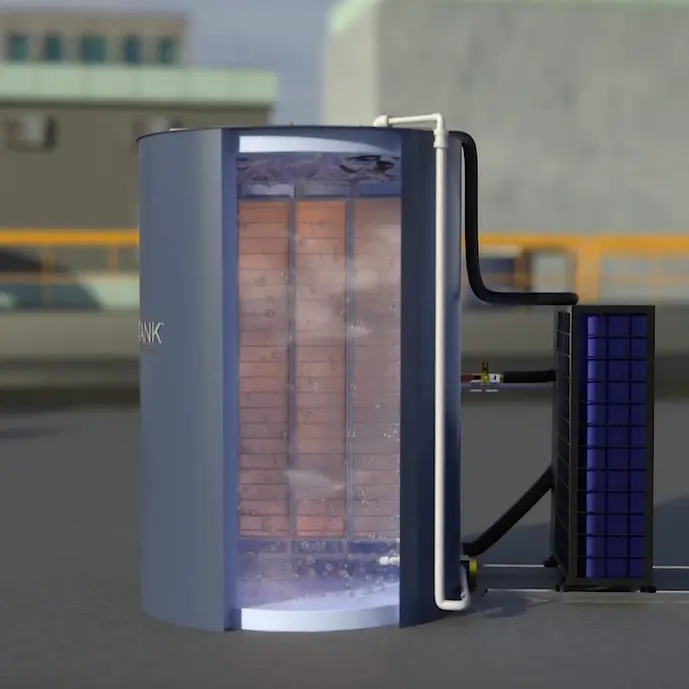
The Skyradiance system integrates three core technologies that work together to produce and store cooling. The first component is the radiative cooling panel, which is coated with the passive cooling film and installed on rooftops where it has direct exposure to the sky. The second component is a water cascade cooling module. Water flows through serpentine piping beneath the radiative film. As the water cascades downward through the module, heat transfers to the film and is radiated away. The third component is a thermal storage tank, where cooled water can be stored and used when cooling demand occurs. This allows cooling energy to be banked and delivered when needed rather than only when the panels are actively rejecting heat.
How does thermal storage improve radiative cooling?
Thermal storage makes radiative cooling systems far more flexible. Instead of requiring perfect alignment between cooling production and cooling demand, the system can produce cooling whenever conditions allow and store it for later use. Thermal Energy HQ’s Thermal Tank technology enables large volumes of cooled water to be stored efficiently. This allows Skyradiance installations to operate as part of a larger cooling infrastructure rather than as a standalone technology.
How does Skyradiance integrate with building cooling systems?
Skyradiance can integrate with conventional hydronic cooling systems. In a typical configuration, heat from the building moves through an air handler or hydronic loop into a condenser tank. That tank is connected to rooftop Skyradiance modules. The panels reject the heat to space, cooling the circulating fluid. The cooled fluid then returns to the building to absorb additional heat. This approach reduces the workload on chillers and heat pumps while lowering electricity consumption.
How much cooling can a Skyradiance module provide?
A typical Skyradiance module has a collector area of approximately 0.88 square meters. Testing indicates that a module can provide an average cooling power of around 300 watts, resulting in roughly 2,600 kWh of cooling energy per year. Because the modules can be installed in arrays, the cooling capacity scales with the number of panels deployed.
How much rooftop area is required?
This makes the technology well suited for buildings with large flat rooftops, including commercial facilities and industrial buildings.
How efficient is Skyradiance compared to conventional cooling?
Traditional chillers typically have a coefficient of performance (COP) between 3 and 6. Skyradiance systems, by contrast, can achieve estimated COP values between 50 and 80, because the system relies primarily on passive heat transfer rather than mechanical energy. The only electricity required is for circulation pumps.
What are the economics of Skyradiance?
Preliminary modeling suggests promising economics. Assuming an installed module cost of approximately $700, and electricity prices around $0.25 per kWh, each module could generate roughly $188 in annual cooling value. Under those assumptions, the system would have a payback period of roughly 3.7 years. As electricity costs increase, the financial benefits improve.
Where can Skyradiance be deployed?
Examples include:
- Data centers
- Commercial buildings
- Industrial facilities
- Telecommunications equipment
- Cold storage warehouses
- District cooling systems
Any facility with a large rooftop and continuous cooling demand may benefit from the technology.
Can Skyradiance work alongside solar power?
Yes. In some building designs, Skyradiance arrays can be installed alongside photovoltaic panels. For example, one side of a rooftop structure could host radiative cooling modules while the other side generates electricity with solar PV. This approach allows buildings to both produce energy and reject heat using complementary technologies.
Why is radiative cooling important for the future of energy?
Global cooling demand is expected to grow dramatically over the coming decades. As temperatures rise and economies develop, more buildings require air conditioning and industrial cooling. Traditional cooling solutions increase electricity demand and strain power grids. Radiative cooling technologies like Skyradiance introduce a new paradigm—one in which cooling can occur with minimal electrical input. This may become an important part of future energy infrastructure.